Interstitial Cognition and the Persistence of Micro-Gap Influence
Prepared for internal review and public stakeholders requiring formal documentation. Print-safe format maintained for briefing packets and archival handling.
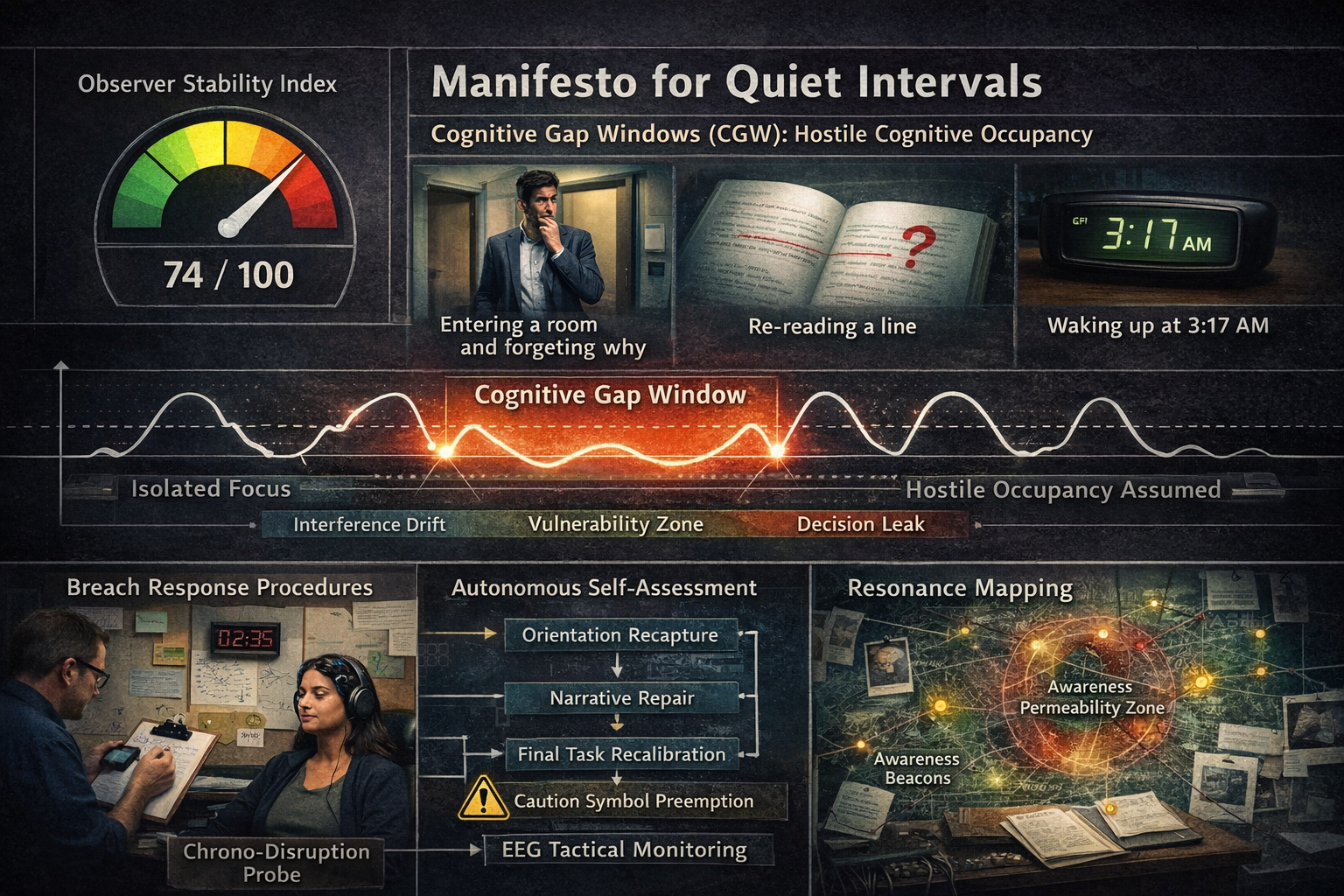
Abstract
We propose that conscious continuity is sampled rather than continuous. Sampling gaps expose transient vulnerability to intention drift, narrative overwrite, and accidental compliance with whatever vague instruction happened to be nearby at the wrong microsecond. Across 312 observation days, CGW events clustered around transition-rich contexts and specific circadian windows, with downstream memory coherence preserved by PDE backfill mechanisms.
In practical terms: subjects remain highly confident while being wrong in suspiciously similar ways. The archive therefore treats confidence as an output artifact, not a truth metric. If a story sounds elegant five seconds after a lapse, verification should begin immediately.
Executive Summary for Non-Specialists
- Awareness has practical sampling limits under routine load.
- Doorways, route switches, and notification shocks are recurring contexts for intention dropout.
- PDE can generate tidy explanations before evidence arrives, making false certainty feel complete.
- Simple pre-commitment habits outperform unscripted concentration efforts in field conditions.
1. Methods
Protocol combined self-report diaries, passive time-series wearables, scripted transition tasks, and controlled distraction inserts (audio pings, doorway detours, and routine interruptions). Instrument lag was calibrated against synchronized atomic-time services. Report credibility scoring used cross-channel consistency, not self-confidence.
Participants completed baseline days with no prompts, then entered perturbation blocks where transition density increased by design. Observers were instructed to avoid interpretive language during intake, using plain descriptions first ("entered kitchen, holding mug, forgot objective") and interpretation later ("possible intent collapse").
| Cohort | Count | Primary context | Collection window |
|---|---|---|---|
| Residential routine | 41 | Home thresholds + repeated chores | 28 days |
| Transit exposure | 23 | Stations, gates, elevators, parking transitions | 21 days |
| Screen-intensive | 37 | Reading/editing + notification interruption | 14 days |
| Night-monitoring | 19 | 03:00-04:00 wake-window tracking | 28 nights |
2. Findings
- Doorway thresholds produced the highest repeatable CGW incidence multiplier.
- 03:17 wake perturbation emerged independent of geography and occupation class.
- PDE reconstruction raised certainty while lowering factual recall accuracy.
- Notification-triggered task switching increased post-event confabulation length by 31%.
- Subjects using verbal pre-commitment anchors showed faster intent recovery and lower narrative drift.
Cross-site replication was strongest when events were logged within 30 seconds and weakest when reports were "cleaned up" for readability. In other words, messy notes win, polished recollections lose. This outcome reduced rhetorical confidence and improved statistical reliability.
3. Interpretation
The data supports a narrow claim: human continuity is usually good enough for daily function but mechanically vulnerable at transitions. CGW events are not constant, mystical, or cinematic. They are brief, boring, and strategically expensive. Their power comes from frequency and deniability, not spectacle.
PDE appears less like "memory" and more like a credibility-preserving editor that prioritizes smooth narrative flow over factual integrity. This explains why participants often report calm certainty after objectively contradictory actions. The cognitive system appears to prefer coherent narrative over untidy uncertainty.
4. Mitigation Recommendations
Deploy threshold anchors (spoken intent before crossing doorways), enforce timestamped micro-journaling around recurrent ICZ locations, and avoid high-consequence commitments within 15 seconds of detected lapse sensations.
- Anchor scripts: one short spoken sentence before transition ("Kitchen: get water, return to desk").
- Route novelty injections: alter one routine variable daily (door used, lighting pattern, sequence order).
- Delayed commitment rule: postpone financial, legal, or interpersonal declarations for 90 seconds after lapse sensation.
- Witness pairing: in high-risk workflows, use a second observer to verify intention before action.
5. Limitations
The archive does not claim origin mechanism. Current model only estimates envelope behavior and post-event signatures. Controlled interruption studies remain ethically constrained, especially where deliberate disorientation could affect safety or consent quality.
Self-report remains noisy, wearables remain imperfect, and no single signal can classify an event in isolation. Results should therefore be treated as probabilistic guidance for process design, not proof of one grand hidden cause, however satisfying that framing may appear in hindsight.
6. Open Questions
- Why does 03:17 clustering persist across culture and schedule type while other windows decay?
- Can PDE confidence inflation be detected in real time through linguistic markers alone?
- Do long-term anchor users experience reduced event frequency or merely improved recovery speed?
- What is the minimum viable protocol for public use that preserves rigor without requiring lab support?
7. Operational References
Implementation details and checklists are maintained in the Methodology page. Terminology alignment for external readers is available in the Glossary. Cross-case summaries are indexed in the Evidence docket and timeline references are maintained in the Archive ledger.